“Special population” means any group whose exposure differs enough from the studied population that the approved dose may not carry over. Usually a physiological change alters clearance, volume or protein binding, and the dose has to follow.
Renal impairment
Reduced renal function only matters if it matters for this particular drug. Two things have to be true at once:
- The drug is substantially cleared by the kidney. A conventional threshold is more than about 30% of a dose eliminated unchanged in urine. Below that, even complete renal failure changes total clearance very little.
- Renal function is reduced enough that the resulting exposure change is clinically relevant.
A renally cleared drug given to someone with normal kidneys is fine, and reduced renal function doesn’t matter much for a drug the kidney barely clears. That said, renal impairment isn’t only a problem for renally cleared drugs. Uraemia alters protein binding and can reduce the activity of some hepatic enzymes and transporters, so a purely hepatically cleared drug can still show altered exposure.
The choice of marker matters too. Creatinine clearance from Cockcroft-Gault and eGFR from CKD-EPI aren’t interchangeable: the first estimates a clearance in mL/min, the second a body-surface-normalised rate in mL/min/1.73m². Using one where a model was built on the other introduces a systematic size-related bias. In paediatrics it’s worse, because creatinine production scales with muscle mass, which changes quickly with age.
Hepatic impairment
This is harder than renal, because there’s no single number that summarises hepatic clearance the way creatinine clearance approximates renal function. Child-Pugh is the usual way to stratify, but it’s a composite clinical score rather than a measure of metabolic capacity, and it only loosely correlates with the activity of any particular enzyme.
What changes: enzyme expression falls, hepatic blood flow falls, portal shunting increases bioavailability for high-extraction drugs, and albumin falls, which raises the unbound fraction. That last one is why total concentration can be very misleading here. Total drug can look unchanged while unbound drug, the pharmacologically active part, has gone up a lot.
Pregnancy
Several changes push in different directions, so the net effect depends on the drug:
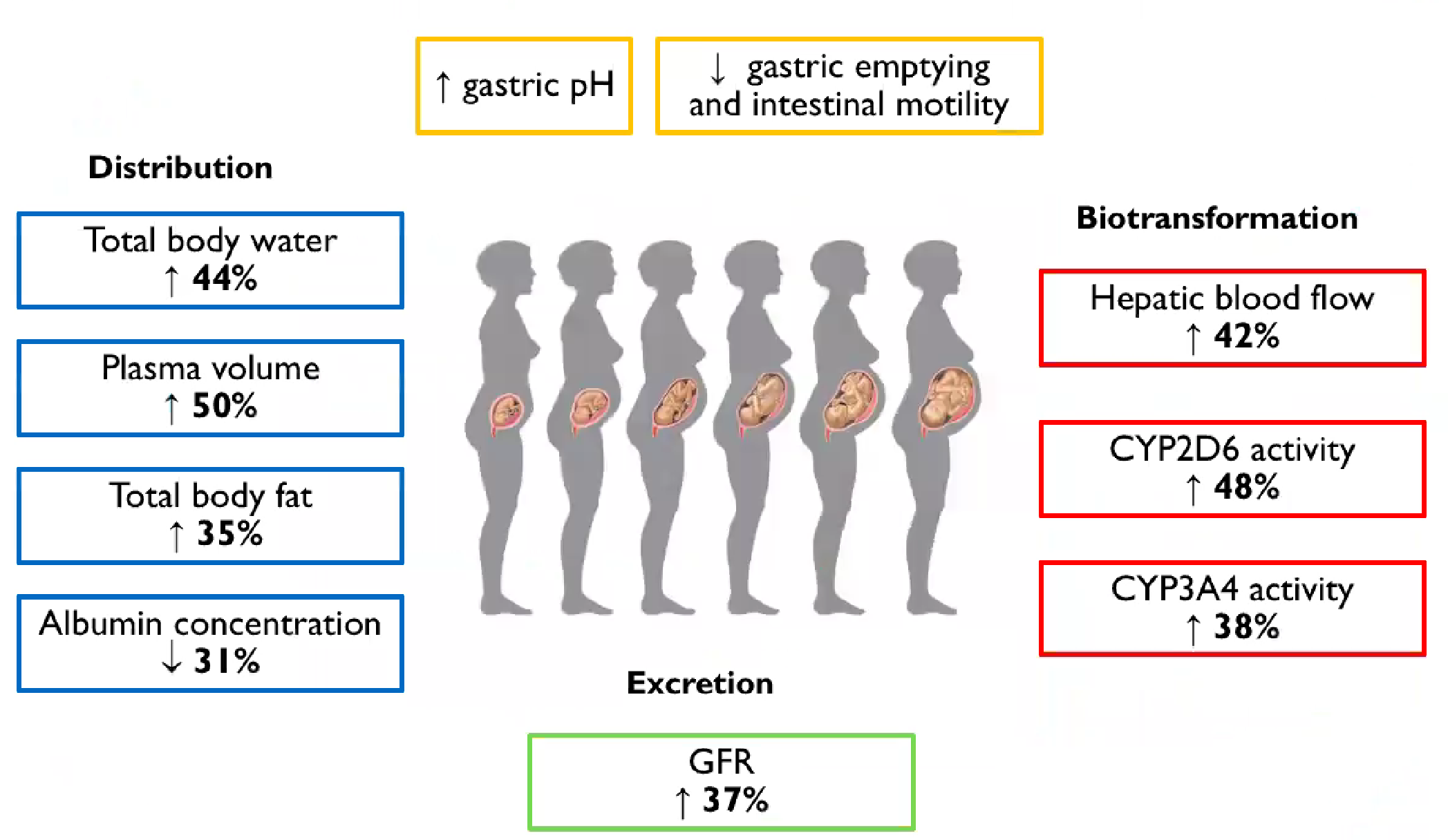
- Plasma volume rises by roughly 40-50%, increasing volume of distribution for hydrophilic drugs.
- Glomerular filtration rate rises by roughly 50%, increasing renal clearance.
- Albumin falls, raising unbound fraction.
- Enzyme activity shifts both ways: CYP3A4, CYP2D6 and CYP2C9 activity increases, while CYP1A2 and CYP2C19 activity decreases.
So a CYP1A2 substrate and a renally cleared drug move in opposite directions, and a drug cleared by both routes may hardly change. The effects also differ between trimesters, so a single “pregnancy dose” may be wrong for part of the pregnancy.
Paediatrics
Children are not small adults. Simple weight-proportional scaling fails for two separate reasons.
Size is handled by allometric scaling: clearance scales with weight to the power 0.75, volume to the power 1. That alone explains most of the difference between a 70 kg adult and a 30 kg child.
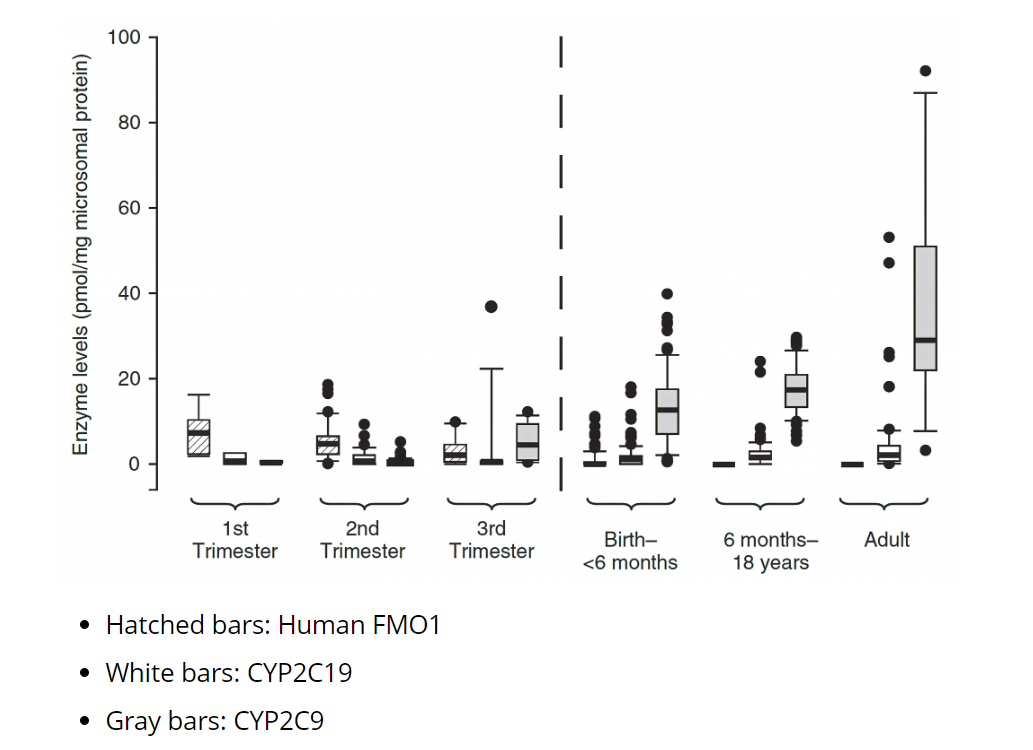
Maturation has nothing to do with size. Enzyme systems come online on their own schedules over the first months to years of life, so a neonate can have a fraction of the metabolic capacity allometry would predict. CYP3A7 is expressed in the fetus and replaced by CYP3A4 after birth. UGT activity matures slowly, which is the mechanism behind the chloramphenicol “grey baby” cases. Renal function also matures over roughly the first year.
That’s why paediatric models usually include both an allometric term and a maturation function of post-menstrual age, and why scaling an adult dose by weight alone goes most wrong in the youngest patients.
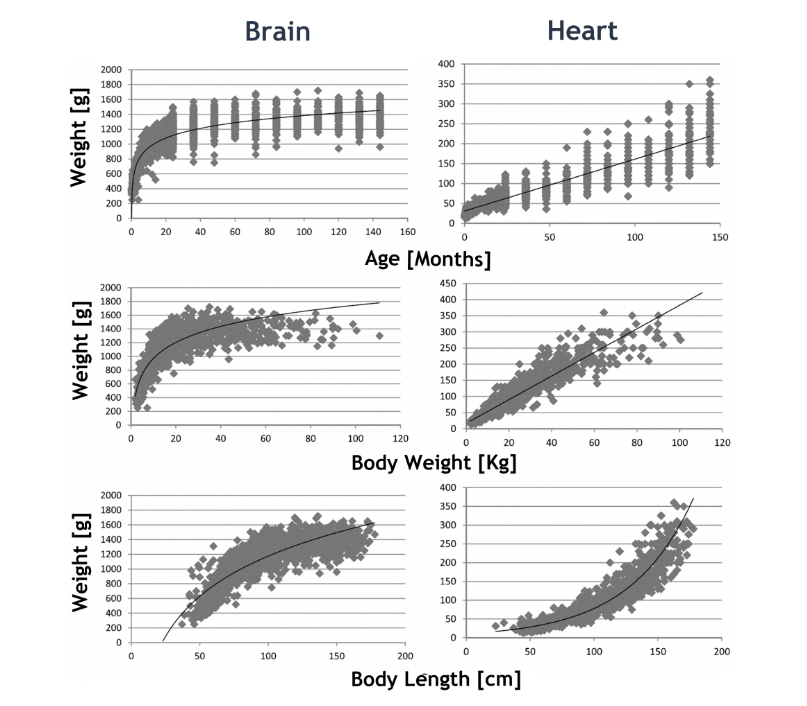
Organ sizes relative to body weight also change with age:
So do enzyme expression and metabolic rate:
Does it change the dose?
For all of these populations the question is which parameter changed, and whether that change moves exposure enough to matter. A covariate with a statistically detectable effect on clearance that moves AUC by 10% doesn’t justify a dose change. One that moves it threefold does. Making that call is the step between a covariate analysis and a dosing recommendation.